Fireplace and chimney service in the West Valley
From Sun City's 1970s streets to Buckeye subdivisions finished last year, the West Valley spans every age of Valley house. The inspection is free in all of them.
No part of the Valley covers a wider range of house ages than the west side. In the Census Bureau's 2020 to 2024 survey the median home in Sun City dates from 1973, and 89 percent were built before 1980. Glendale's median is 1986, with 35 percent of homes older than 1980. Then the numbers flip: Peoria's median is 1999, Surprise 2005, Goodyear 2007 and Buckeye 2011, and in Buckeye nine homes in ten were built in 2000 or later.
The gas map follows the age map. Utility gas is the main heating fuel in 51 percent of Goodyear homes and 45 percent of Surprise homes, against 22 percent in Glendale, where three homes in four heat with electricity. A Goodyear or Surprise house is far more likely to have gas piped near the hearth and the patio, and that shapes the work: older Glendale homes call for flue and firebox repairs, the newer cities for gas parts, glass, chase covers and backyard fire features.
Sun City and Sun City West
Del Webb opened Sun City's first model homes on January 1, 1960, and the Census survey shows how little has been added since: 3 percent of homes date from 2000 or later. Fireplaces here predate the 1998 clean-burning rule, so the ones we see are older wood-burning units, some masonry, some early metal boxes, many unlit for years.
For an owner who wants a fire on a winter evening without hauling wood, a gas log set or insert is the usual answer. Only 28 percent of Sun City homes heat with utility gas, though, so the first question is whether a line can reach the hearth; HomeGuide puts extending one at $350 to $2,000. Owners who never use the fireplace sometimes take it out instead. Removing the fireplace typically runs $500 to $2,500, and $3,000 to $6,000 when the chimney comes down with it. Sun City West, the later community a few miles northwest, raises the same choices.
Glendale, Peoria and El Mirage
Glendale's housing is mostly from the 1980s and 1990s, with 44 percent built between 1980 and 1999, and Peoria splits almost evenly between that era and the years since 2000. A house from those decades often has a factory-built wood-burning fireplace installed before the 1998 deadline: a steel firebox lined with refractory panels, a metal chimney inside a chase, sometimes a set of glass doors. The panels crack with age, and Fixr puts a replacement at $100 to $300 per panel. A new glass door unit runs $549 to $998.
In Peoria, 38 percent of homes heat with utility gas and 76 percent are owner-occupied, so the questions lean toward dropping a gas insert into one of those older wood boxes. An insert installed runs $2,000 to $5,000 in HomeGuide's 2026 guide. We also work in El Mirage, next to Surprise.
Surprise, Goodyear, Buckeye and Avondale: gas from the start
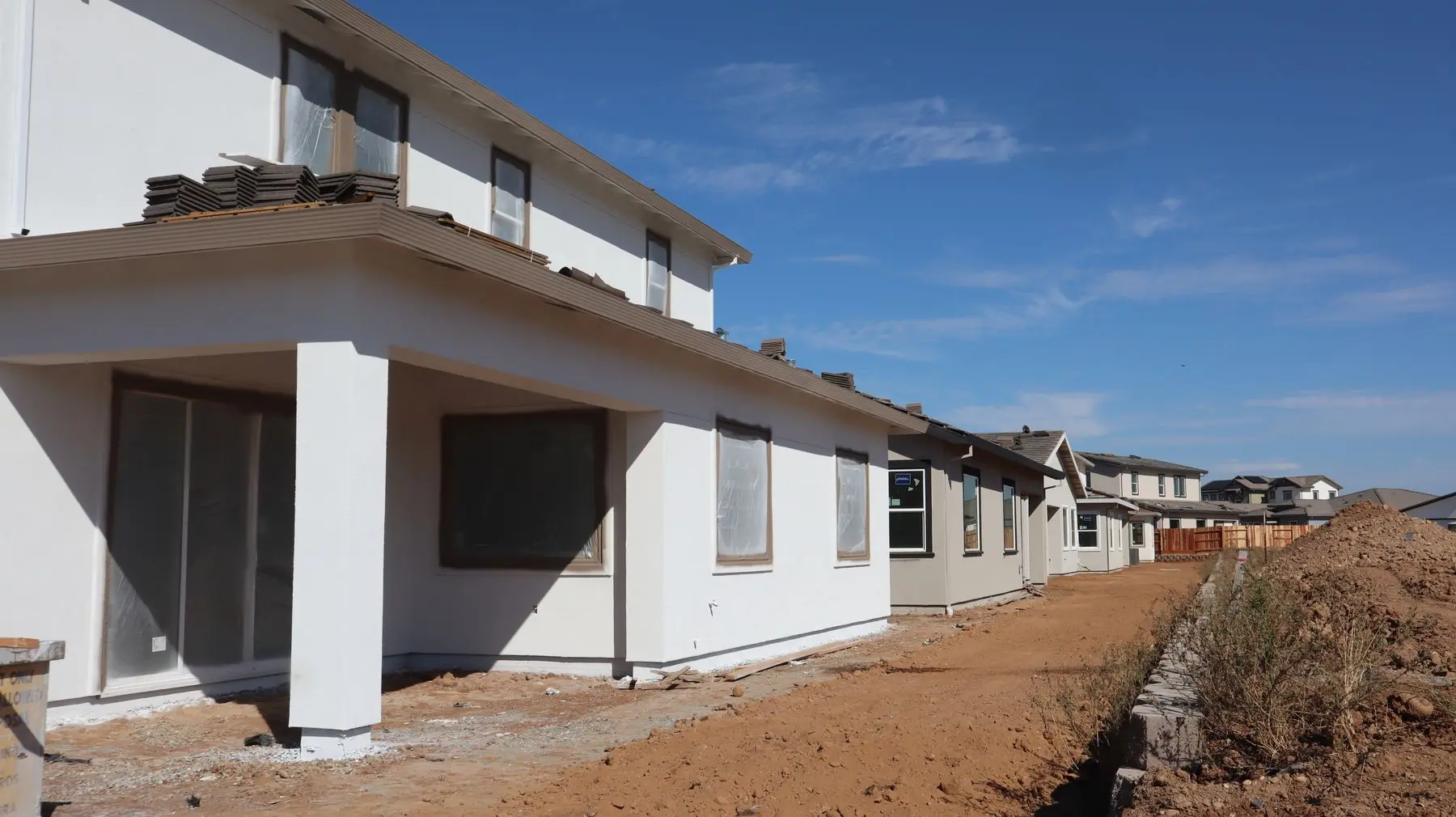
In Surprise, Goodyear and Buckeye, three quarters or more of homes were built after December 31, 1998, the date Arizona law (A.R.S. 9-500.16) set for Valley cities to stop allowing new open wood fireplaces. The fireplace in these houses is a factory-built gas unit, often a direct-vent box behind sealed glass, with its flue running up a stucco chase. Buckeye is still adding them quickly: the Census Bureau estimated the city at 125,445 people in July 2025, up 37.1 percent from the April 2020 count.
Much of the work out here happens in the backyard. Patio fireplaces, fire tables and gas fire pits are common behind newer homes in Goodyear, Avondale, Litchfield Park and Tolleson, and their burners take sun, dust and monsoon water all summer. Diagnosing an outdoor burner is free and the repair is priced on the spot. HomeGuide's 2026 guide puts a new gas fire pit at $3,500 to $8,000 installed, and a new prefab outdoor fireplace runs $1,500 to $9,000. Many master-planned communities have CC&R rules on fire features; check your HOA's architectural guidelines before adding or moving one.
Dust, monsoon wind and the summer wood ban
Haboobs reach Sky Harbor a few times a year on average, according to a National Weather Service technical memo, and each one leaves grit in every open burner, log set and firebox it crosses. On a fire pit, dust packs the burner ports and the gap around the igniter. On a roof, wind-driven monsoon rain between June 15 and September 30 finds the seams of a chase cover and any gap in the flashing. Fixr puts flashing repair at $200 to $300, and a chimney cap runs $200 to $850.
Wood fire pits have a long off-season. Maricopa County prohibits recreational wood fires, wood chimineas and outdoor wood pits from May 1 through September 30 in Area A, its metro air-quality zone, and on No Burn Days declared in the cooler months wood fireplaces are off as well. Fines under Ordinance P-26 begin with a warning notice and climb to $50, $100 and $250. Gas features are exempt from both rules, which is why West Valley owners ask about a gas burner kit for an old wood pit; that is priced at the inspection.
FAQ
West Valley questions
Can I use my fire pit today?
If it burns wood, check two things: whether Maricopa County has declared a No Burn Day (Clean Air Make More app, or 602-506-6400) and the date, because wood pits are banned from May 1 through September 30 in Area A. A gas or propane fire pit is not covered by either rule.
Do I need a chimney sweep for a gas fireplace?
Not a sweep in the wood-fire sense, since gas that burns properly leaves little soot. A gas unit still needs its burner, pilot, glass gasket and vent checked, and its chase cover looked at from the roof. Our free inspection lights the unit and covers all of it, and any repair is priced in writing at that visit.
What is the difference between a chase cover and a chimney cap?
A chase cover is the sheet-metal lid that closes the top of the framed chase on most newer West Valley homes; the flue pipe passes through it. A chimney cap sits over the flue opening itself to keep out rain, birds and debris. Fixr puts a chase cover replacement at $300 to $700; HomeGuide puts a cap at $200 to $850.
How much does it cost to get a chimney inspected?
Phoenix-area companies that publish a price charge $89 to $150 for an inspection. Ours is free: we light any gas unit, check the firebox, vent or flue, cap and chase, take photos and write down a price for anything that needs work.
What are the fire pit HOA rules in Surprise and Goodyear?
There is no Arizona statute written specifically for HOA fire pit rules; communities rely on their recorded CC&Rs. Many master-planned communities in Surprise, Goodyear and Buckeye have rules on fire features, so check your HOA's architectural guidelines before adding or moving one.

Book online
Pick a window. We'll bring the meter.
Free inspection in a 3-hour window: 8 to 11, 11 to 2, or 2 to 5, Sunday through Friday. We call to confirm before we head out.