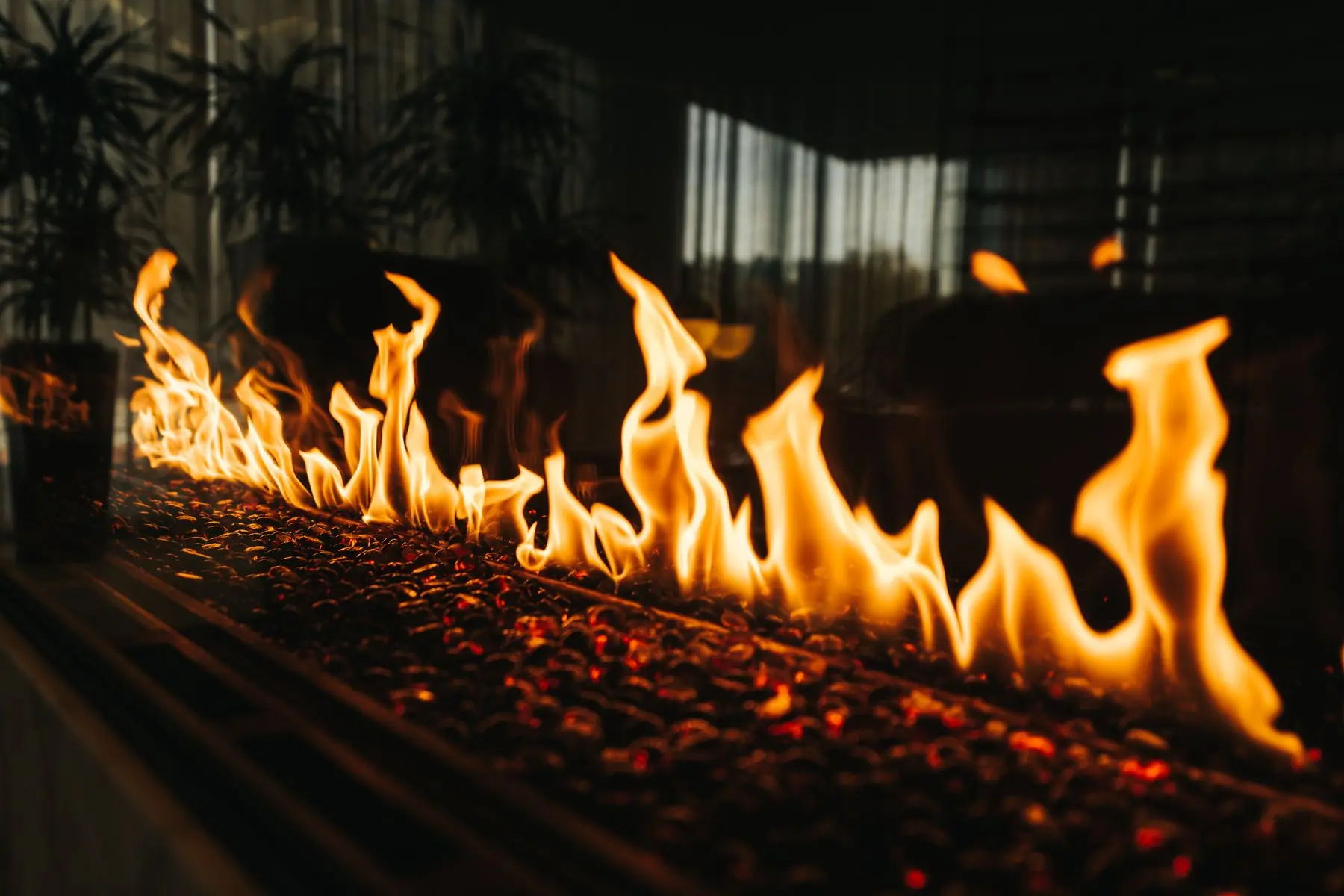
Gas Fireplace Repair in the Phoenix Valley
We light the fireplace, trace the fault to one part, and write that part's price down before we touch it. Most repairs come down to an igniter, a pilot assembly, a thermocouple or thermopile, or the gas valve.
A gas fireplace is a short chain of parts, and it only makes a flame when every link holds. The igniter or piezo sparker lights a small pilot. The pilot heats a thermocouple or thermopile, which produces a tiny voltage. That voltage tells the gas valve it is safe to open the main burner. When one link is weak, the fireplace does something specific: it sparks with no flame, lights and drops out, or holds a pilot that never brings up the burner. Reading that symptom correctly is most of the repair, and it is why we test before we name a part.
Around here the chain gets tested at an odd time of year. Sky Harbor's average first 100°F day is May 2 and the last is October 5, by NWS Phoenix's 1991–2020 figures, so most units sit unused for five months or more inside a closed firebox or a stucco chase that bakes all summer. Nothing looks wrong until the first cool evening in late October or November, when half the neighborhood reaches for the remote in the same week. We work across Phoenix, the West Valley, the East Valley and the Southeast Valley, Sunday to Friday.
Signs you need this
- The igniter clicks or sparks but nothing catches
- The pilot lights, but the main burner never comes up
- Flame starts, then dies within a minute or two
- Remote or wall switch does nothing, even with fresh batteries
- Flames are tall, lazy and yellow, or leave soot on the glass
How we do it
- Light it with you thereWe run the fireplace from your own switch or remote so we see the exact failure you see, not a version of it.
- Measure, don't guessA meter on the thermocouple or thermopile and a close look at the pilot flame tell us which link is weak before any part comes out.
- Price on paperYou get the part, the price and photos. Nothing is replaced until you say yes.
- Fix, relight, checkAfter the repair we run the burner, look at the flame picture and the glass seal, and test the gas fittings we opened for leaks.
What does each gas fireplace part cost to replace?
HomeGuide's 2026 fireplace repair guide gives these installed ranges, and they are the ranges we quote against: an igniter $90–$150, a pilot assembly $100–$350, a thermocouple $150–$350, and a thermopile or gas valve $150–$300. The spread inside each range is mostly the brand and how hard the part is to reach. A linear unit with the valve buried behind a front panel takes longer than an older log set with its controls behind a lift-off grille.
The diagnosis is free. If two parts are tired, which is common after a long idle stretch, we tell you which one caused today's failure and which one is close behind, and you decide whether to do both now or wait.
Standing pilot or electronic ignition: why it changes the repair
Older units, common in Glendale, Mesa and central Phoenix houses from the 1980s and 1990s, usually burn a standing pilot and run on a thermopile, so they need no house power at all. Many newer fireplaces in Gilbert, Goodyear or Queen Creek use intermittent pilot ignition instead: a control module, a battery pack or plug-in adapter, and a flame sensor. Those fail differently. A dead backup battery or a loose adapter can look exactly like a broken fireplace.
On electronic units we check the power side first, because it is the cheapest fix. On millivolt units we start at the pilot flame, since a weak or lifted pilot is behind plenty of thermopile replacements that never needed to happen.
When to stop and call Southwest Gas instead
A rotten-egg smell near the fireplace is the odorant, mercaptan, that is added to natural gas so leaks get noticed. Do not try the switch, the remote or the thermostat. Leave the house, then call 911 and Southwest Gas at 1-877-860-6020 from outside; Southwest Gas takes leak calls 24 hours a day, customer or not. Once the utility has cleared the house, we can come and repair the fireplace.
Whatever the fault, a working carbon monoxide alarm belongs in any home with a gas fireplace. Phoenix's adopted residential code requires CO alarms in new homes and permitted remodels, and we recommend one in every house we work in.
FAQ
Gas Fireplace Repair questions
How much does gas fireplace repair cost in Phoenix?
Most single-part repairs land between $90 and $350 using HomeGuide's 2026 ranges: igniter $90–$150, pilot assembly $100–$350, thermocouple $150–$350, thermopile or gas valve $150–$300. The diagnosis, with the fireplace lit and tested, is free, and your price is written down before any work.
Why won't my gas fireplace light after the summer?
Months without use is the usual reason. Fine dust settles on the pilot hood and burner ports, batteries in the receiver run down, and a thermocouple that was marginal last winter finally reads too low. Many of these turn out to be a cleaning and adjustment rather than a new part, which is why we test before we quote.
Can a plumber fix a gas fireplace?
A plumber can work on the gas piping that feeds it. The fireplace itself, with its pilot, sensors, valve, venting and glass seal, is appliance work that follows the maker's manual for parts and settings. That appliance side is the part we handle.
What should I do if my gas fireplace won't turn off?
Turn the fireplace's own shutoff to off: usually a key valve on the wall or a quarter-turn valve behind the lower grille. If you can't find it or the flame keeps burning, shut the gas at the meter if you know how, then call us. A valve that sticks open needs replacing, not resetting.
Do you repair propane fireplaces?
Yes. Propane is less common in the metro, but it shows up in Apache Junction, where Census data puts propane heat at about 4% of homes, the highest share in our area, and on the rural edges of the Valley. Propane units use different orifices and pressure settings, and we check those as part of the repair.
Related
Gas fireplaces, inserts and glass

Book online
Pick a window. We'll bring the meter.
Free inspection in a 3-hour window: 8 to 11, 11 to 2, or 2 to 5, Sunday through Friday. We call to confirm before we head out.