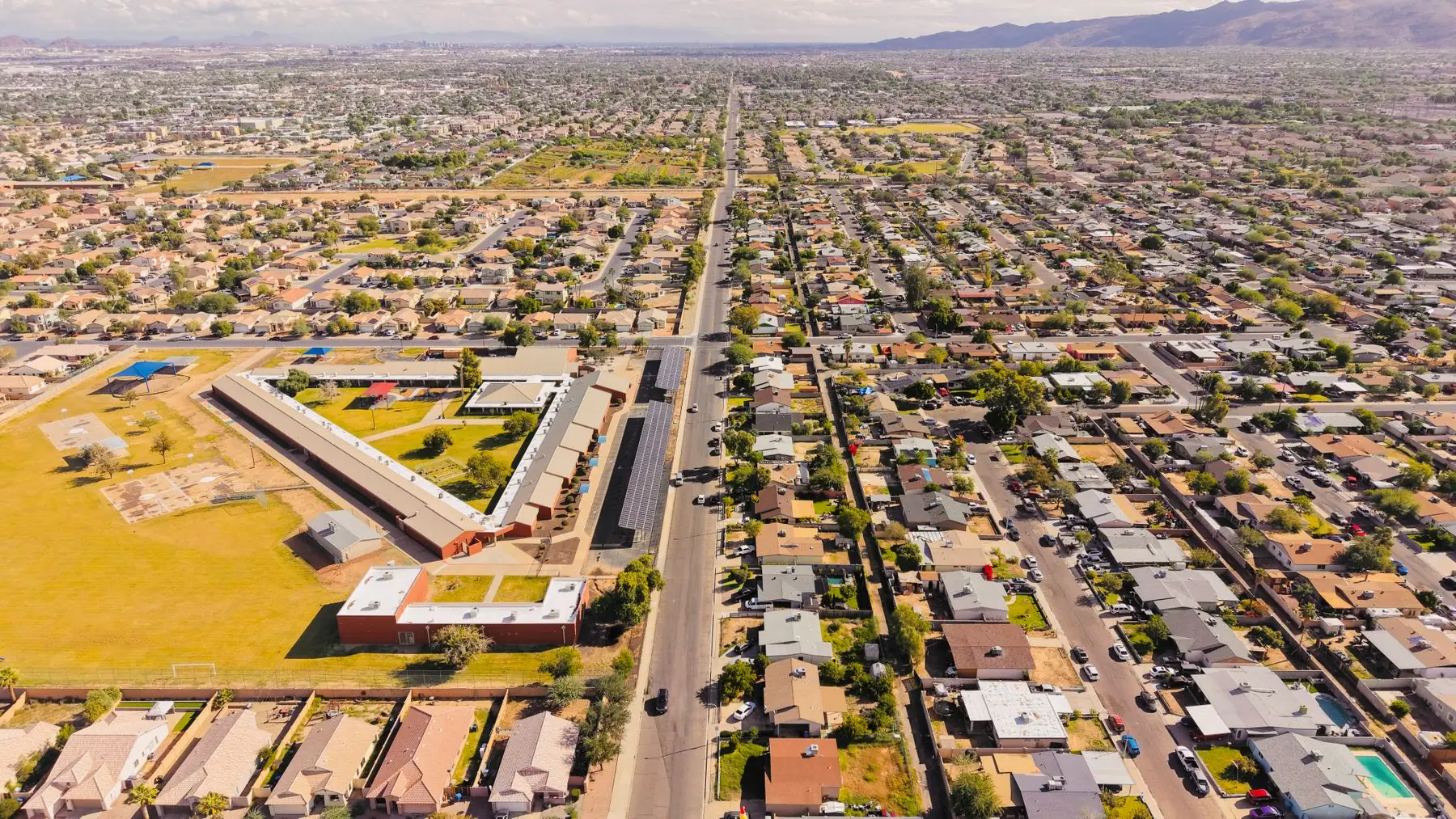
Fireplace and fire pit service in the Southeast Valley
Nearly every fireplace in the Southeast Valley was built for gas, and many of the best ones are outside. We inspect indoor and outdoor units for free.
This is the newest corner of the Valley. In the Census Bureau's 2020 to 2024 survey, 91 percent of Queen Creek homes, 92 percent in San Tan Valley and 93 percent in the city of Maricopa were built in 2000 or later. Gilbert's median home dates from 2003. Chandler is the elder of the group, with a median of 1997 and nearly half its homes built between 1980 and 1999, yet only 10 percent of Chandler homes predate 1980.
Gas is more common here than anywhere else we serve. Queen Creek leads our whole list, with 62 percent of homes heating with utility gas, followed by the city of Maricopa at 50 percent and Gilbert at 43. Owners tend to stay, too: 90 percent of Queen Creek homes are owner-occupied. Put together, the typical Southeast Valley job is a gas fireplace in a family's own house, often with a fire pit or outdoor fireplace on the same gas line.
Chandler and Gilbert: first-generation gas units
A gas fireplace installed in a Chandler or Gilbert house around 2000 is now old enough that its parts give out one at a time. The thermopile weakens and the burner drops out after a few minutes, the pilot assembly corrodes, the glass gasket hardens and stops sealing. HomeGuide's 2026 guide puts a pilot assembly at $100 to $350 and a thermopile or gas valve at $150 to $300. Replacement fireplace glass runs $100 to $350.
Chandler also has a bit of everything older: 1980s homes with factory-built wood units installed before the 1998 deadline, and a tenth of its housing stock from before 1980 with masonry. Those owners ask the conversion question, and HomeGuide's range for turning a wood fireplace into gas is $1,500 to $8,000. We also work in Sun Lakes, just south of Chandler.
Queen Creek and the outdoor fire feature
Queen Creek's median home was built in 2012, the newest on our list. Many of those houses had gas plumbed from day one, which makes a backyard fire pit, a fire table or a full outdoor fireplace an easy addition. Those features work harder than anything indoors: direct sun all summer, dust in every storm, and water standing in a burner pan after a monsoon downpour.
The failures we find are igniters and spark modules, wiring and gaskets aged by sun and heat, fire glass heaped so deep over the burner that the flame starves, and spiders or dust in the ports. Diagnosis is free and the repair is priced on the spot. If you are adding a feature, HomeGuide puts a new gas fire pit at $3,500 to $8,000 installed. Many master-planned communities have CC&R rules on fire features, so check your HOA's architectural guidelines first.
San Tan Valley, Maricopa and part of Queen Creek: Pinal County
San Tan Valley, the city of Maricopa and part of Queen Creek lie in Pinal County. Maricopa County's No Burn Day ordinance, P-26, does not automatically apply there, and Pinal County runs its own air-quality program, so check its rules before lighting a wood fire. In the Maricopa County part of Queen Creek, and in Chandler, Gilbert and Sun Lakes, the Maricopa County rules apply.
On the ground, fireplaces look much the same on both sides of the county line. San Tan Valley's median home dates from 2007, as does the city of Maricopa's, and in both more than nine homes in ten are post-2000. That means gas units, framed stucco chases with sheet-metal covers, and patio fire features, with the chase cover and flashing worth a look after each monsoon. Fixr puts a chase cover replacement at $300 to $700 and flashing repair at $200 to $300. We check what your city or county requires before any gas line work.
Heat, dust and the line from house to patio
Sky Harbor's first 100°F day comes around May 2 on average and the last around October 5, which leaves a Gilbert or Queen Creek fireplace dormant for five months. When it fails on the first cool night, the cause is usually small: an igniter at $90 to $150, a thermocouple at $150 to $350, or a burner choked with summer dust. We light it, watch it run and tell you whether a burner service is all it needs.
Running a new gas line from the meter to a patio fire pit or outdoor kitchen is a common request here; HomeGuide puts a gas line extension at $350 to $2,000. We check what your city requires before that work starts. For any home with a gas fireplace we recommend a working carbon monoxide alarm. And if you ever smell rotten eggs near the fireplace, leave the house without touching switches or controls and call 911 and Southwest Gas at 1-877-860-6020 from outside.
FAQ
Southeast Valley questions
Does the Maricopa County No Burn Day apply in San Tan Valley?
Not automatically. San Tan Valley, the city of Maricopa and part of Queen Creek are in Pinal County, which runs its own air-quality program, so check Pinal County's rules. Chandler, Gilbert, Sun Lakes and the Maricopa County side of Queen Creek follow Maricopa County's No Burn Days, where gas fireplaces and gas fire pits are exempt.
Do I need a permit for a gas line to my fire pit?
Check before you dig. Phoenix lists new gas lines to exterior gas appliances as permit work, and unincorporated Maricopa County has a fast-track permit for a new line to a fire pit or fireplace. We check what Chandler, Gilbert, Queen Creek or Pinal County requires at your address before the work starts.
Gas logs vs gas insert: which is better?
Gas logs sit in an open firebox and give the look of a wood fire with less heat, and a vented set needs the damper held open. An insert is a sealed box with its own vent, puts far more heat into the room and costs $2,000 to $5,000 installed. Most Southeast Valley homes already came with a builder's gas log unit, so the question usually comes up only when that unit is replaced.
Can I put my fire pit on my deck?
Only if the manufacturer lists it for that surface and the clearances in its manual are met; many gas fire pits and tables are meant for a noncombustible base such as pavers or concrete. Check your HOA's architectural guidelines too. We can look at the spot and the gas supply on a free visit.
Should I turn off my gas fireplace pilot light in summer?
On a unit with a standing pilot, many owners shut it off for the hot months, which saves gas and keeps a small flame from adding heat to the house from May to October. Relight it by the steps in the manual before the first cool evening. Newer units with electronic ignition have no standing pilot to turn off.
Book online
Pick a window. We'll bring the meter.
Free inspection in a 3-hour window: 8 to 11, 11 to 2, or 2 to 5, Sunday through Friday. We call to confirm before we head out.